Vendor Real-Time Inventory: export and sync to Google Sheets
Monitor hourly Highly Available Inventory for vendor ASINs and investigate short-term availability changes.
What this report tells you
Vendor Real-Time Inventory provides hourly observations of Highly Available Inventory for your vendor products. Bringing the report into Google Sheets helps you follow short-term changes and inspect the hours around a promotion or a demand spike. It complements the standard Vendor Inventory report, which contains broader period-based inventory and operational measures. “Real-Time” is the report name; its hourly records do not imply an instantaneous view of every stock movement.
Useful columns to start with
Choose a focused set of columns for your task. These are examples from Hopted’s current Vendor picker, rather than an exhaustive field list.
- ASIN — Identify the product behind each hourly inventory observation.
- Start Time — Identify the beginning of the reported hour.
- End Time — Keep the interval end visible and distinguish completed observations.
- Highly Available Inventory — Review units available for sale after cart or other committed units are excluded.
- Marketplace Country Code — Separate availability observations by marketplace.
- Store name — Keep account context when reviewing multiple connections.
Keep Store name, marketplace, date or time fields, and Currency where available. This context helps keep different accounts, periods, and monetary amounts distinct.
How to export Vendor Real-Time Inventory to Google Sheets
1. Connect Amazon Vendor Central to Google Sheets
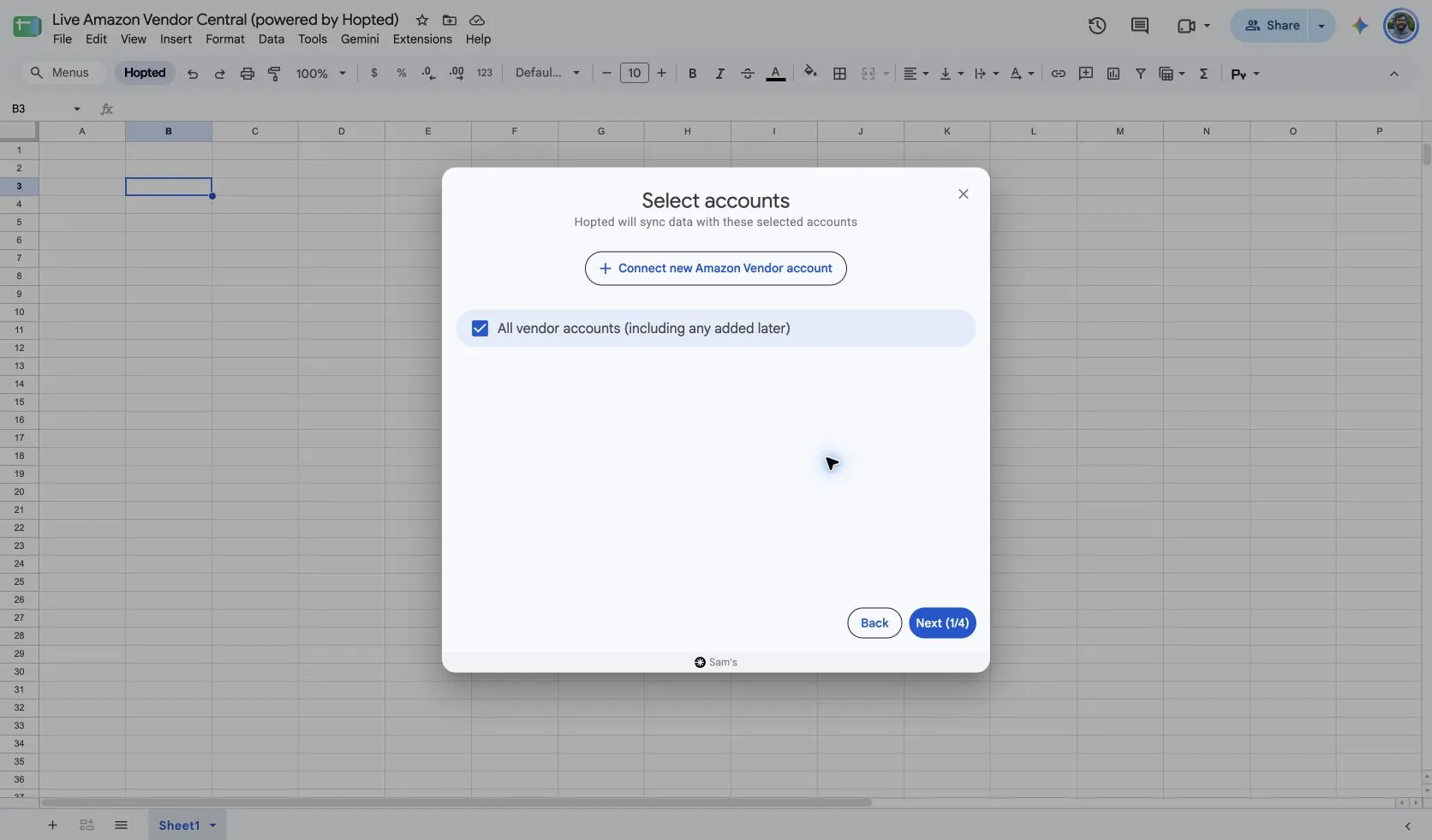
Install Hopted and sign in. Open your Google Sheet, click Hopted, then Add new data sync and Amazon Vendor Central. Select the vendor accounts to include. For a combined view, choose All vendor accounts (including any added later).
2. Choose the source, settings, and columns
Choose Vendor Real-Time Inventory in the source list and use Add beside the fields you need. Review the source settings where present. The screenshot below shows this source in the current Hopted picker.
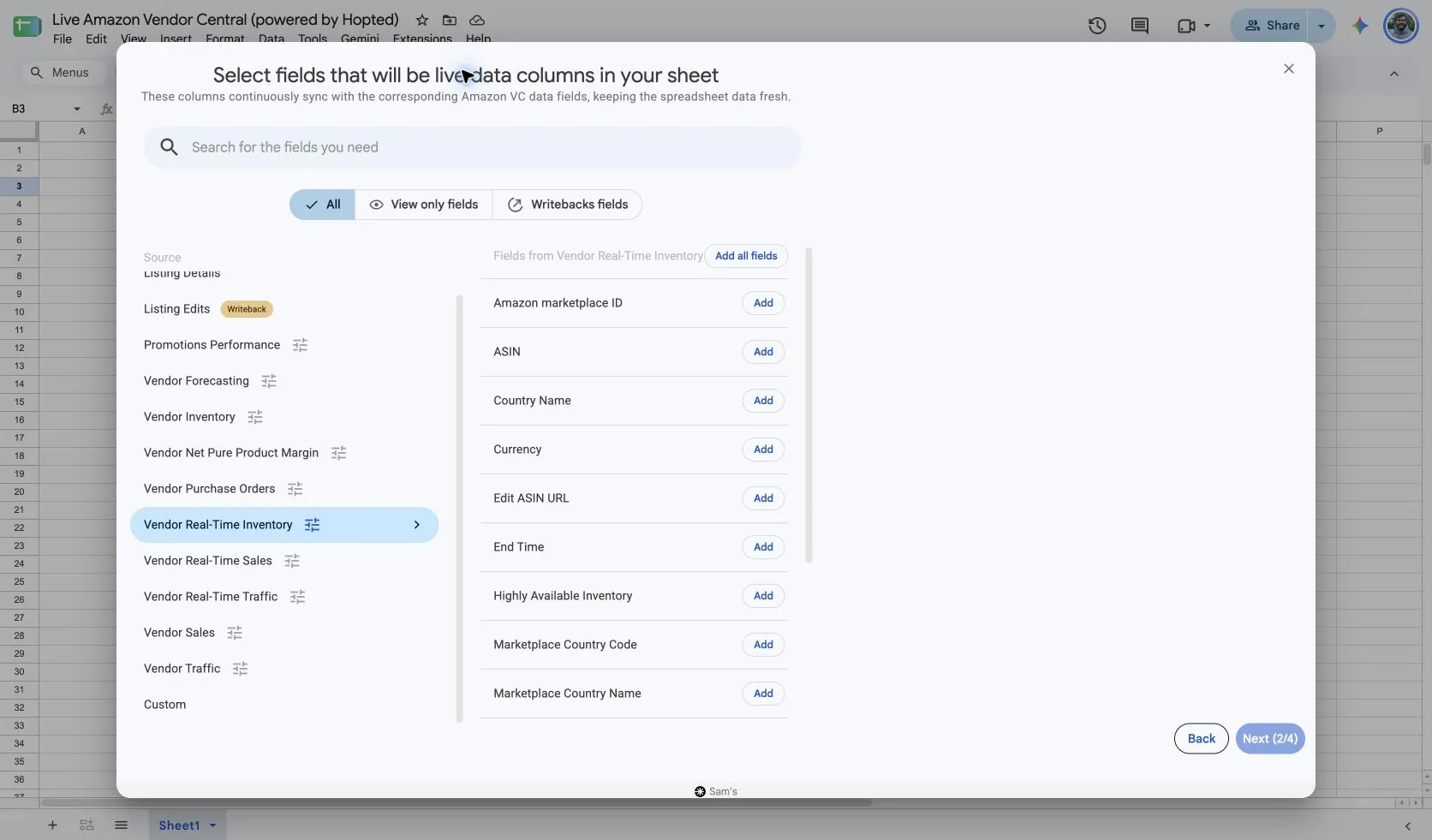
Select Vendor Real-Time Inventory in Hopted. The captured Include records from setting is Last 24 hours, which is a practical starting point for an hourly availability review.
For a broader investigation, choose a supported time range. Hopted allows up to 30 days of lookback with a maximum seven-day span for this source. The newest end of the requested range excludes a short buffer; do not expect the current incomplete hour to be final.
Keep Start Time and End Time in the sheet and retain marketplace context. Use the same hour boundaries when comparing inventory with Real-Time Sales or Real-Time Traffic.
3. Review optional filters
Leave filters unset for a broader import, or add a filter for the specific records you want to review. Check account, date-range, and filter choices when an expected result is missing.
4. Choose a refresh schedule
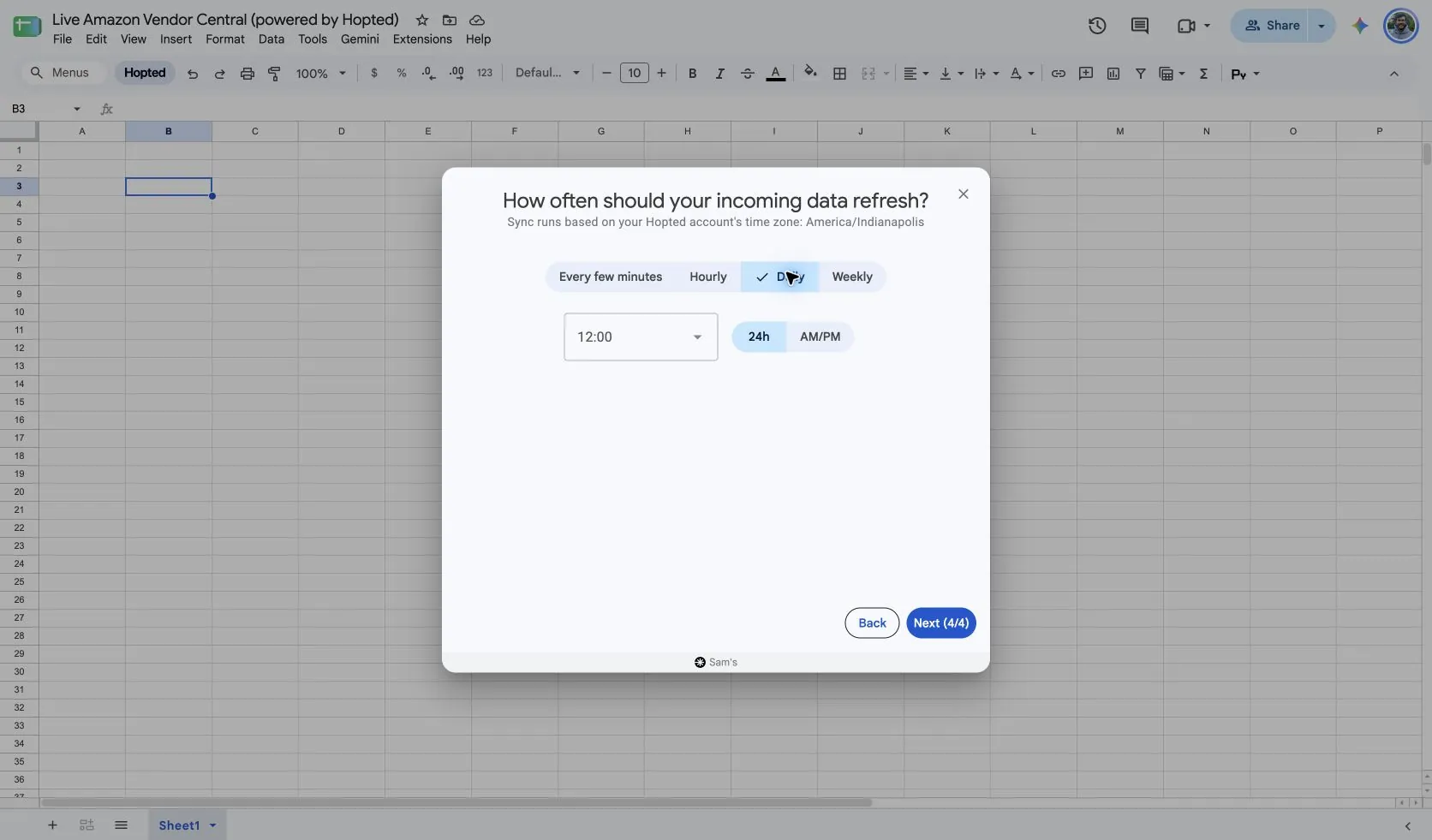
Hopted offers every-few-minutes, hourly, daily, and weekly schedules. The schedule uses the time zone shown for your Hopted account. Choose a cadence that fits the report and your review; a faster schedule cannot make Amazon publish data sooner.
5. Review and create the Sync
Check the accounts, selected fields, source settings, filters, and refresh schedule. Choose Create new Sync when the configuration is ready. Review the imported rows before adding calculations or sharing a dashboard.
How to use the report
- Chart Highly Available Inventory by hour for one ASIN and marketplace. Focus on the direction and the latest completed observation. This can help you identify when availability changed and which interval deserves further investigation.
- Review the hours around a promotion or unusually strong sales period. Compare the inventory observations with Vendor Real-Time Sales, using matching ASINs and time ranges. The comparison can support investigation without proving why stock changed.
- Keep a short-term availability view alongside standard Vendor Inventory and Vendor Purchase Orders. Use hourly observations for near-term monitoring and period-based receipts, open orders, and lead time for supply planning.
What to check before comparing results
Highly Available Inventory is not identical to Sellable On Hand Inventory Units. Amazon’s definition subtracts units in customer carts or otherwise bound for orders from sellable stock. Different measures can therefore show different balances without either being wrong.
Each hourly value is an inventory observation, not a quantity received or sold during that hour. Do not sum these values across hours to calculate total inventory. Compare observations or use the most recent relevant record.
Hourly granularity and a scheduled refresh do not guarantee immediate updates. Data depends on Amazon’s availability, report generation, and the sync schedule. Use the standard Vendor Inventory report when you need its separate operational-health fields.
Availability depends on the vendor account, marketplace, permissions, and the data Amazon supplies. Keep row dimensions intact when joining reports. For longer-term comparisons, review Hopted Data history.
Questions and answers
How do I export Vendor Real-Time Inventory to Google Sheets?
Open Hopted in Google Sheets, choose Amazon Vendor Central, select your vendor accounts, and choose Vendor Real-Time Inventory. Add the columns you need, review its settings and optional filters, then choose a refresh schedule and create the Sync.
Can I add hourly inventory values together?
No. They are observations of an inventory balance. Summing them over time would count the same stock repeatedly.
Why does this differ from Vendor Inventory?
The reports use different time scopes and measures. Highly Available Inventory also excludes units in carts or otherwise committed, unlike a simple on-hand balance.
Sources and verification
Source names, example fields, and setup screens were checked in Hopted’s Vendor Central picker on October 14, 2026. Screenshots come from the supplied “Live Amazon Vendor Central (powered by Hopted)” Google Sheet.
See the Amazon Vendor Central connector for the connection overview, or return to the Vendor Central reports directory.