Vendor Traffic: export and sync to Google Sheets
Track product detail-page glance views and compare shopper interest across ASINs and periods.
What this report tells you
Vendor Traffic shows customer views of the detail pages for your vendor products. Exporting it to Google Sheets gives you a consistent way to review which products attract attention, how interest changes between periods, and where sales deserve a closer look. Its Glance Views metric describes detail-page traffic; it does not measure ad impressions, ad clicks, or a list of individual shoppers.
Useful columns to start with
Choose a focused set of columns for your task. These are examples from Hopted’s current Vendor picker, rather than an exhaustive field list.
- ASIN — Match detail-page interest to the correct product.
- Glance Views — Measure reported customer views of the product detail page.
- Start Date — Identify the beginning of the reporting period.
- End Date — Identify the period end for like-for-like comparisons.
- Marketplace Country Code — Separate traffic from different Amazon marketplaces.
- Store name — Keep connected-account context visible in shared reviews.
Keep Store name, marketplace, date or time fields, and Currency where available. This context helps keep different accounts, periods, and monetary amounts distinct.
How to export Vendor Traffic to Google Sheets
1. Connect Amazon Vendor Central to Google Sheets
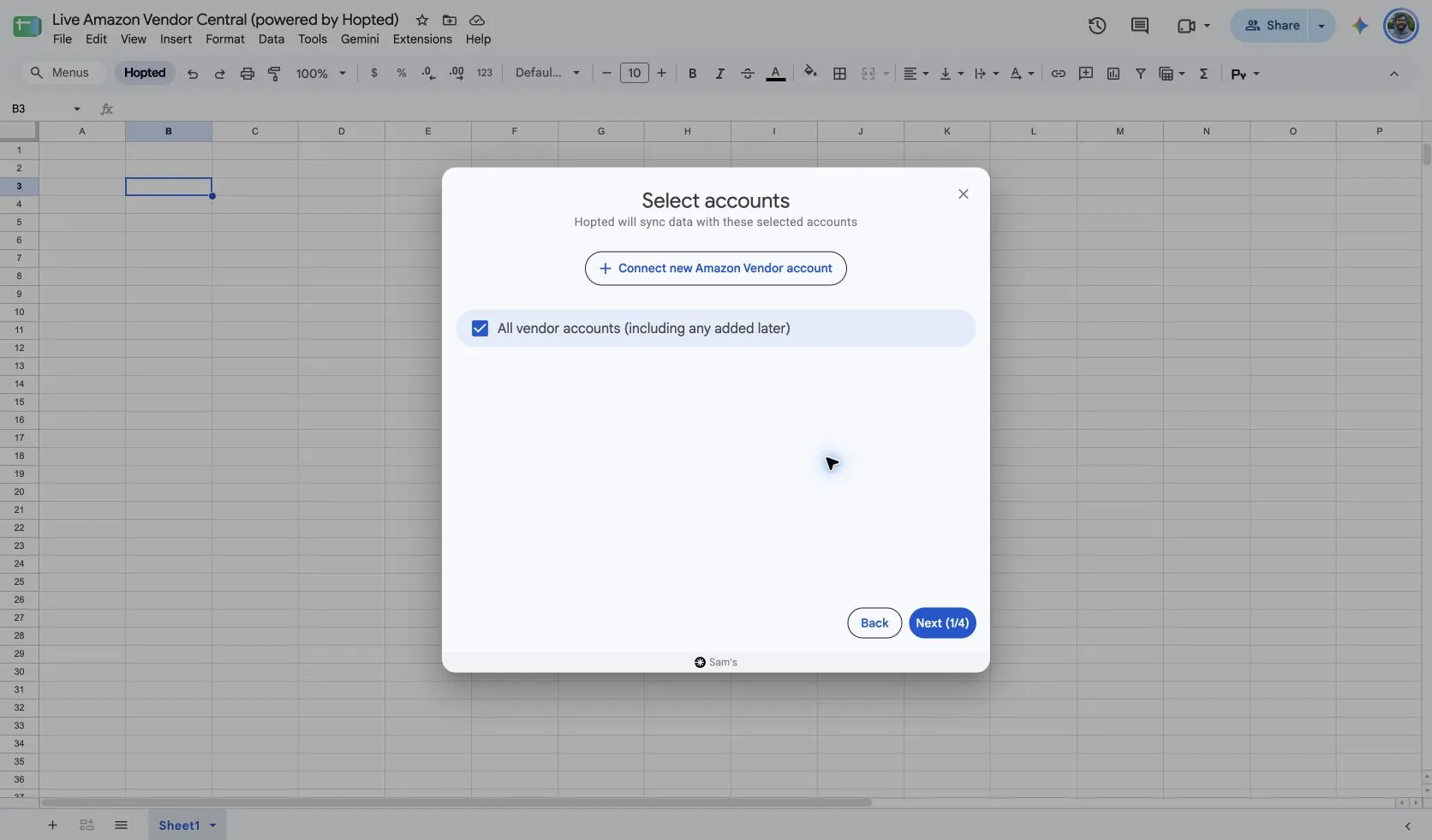
Install Hopted and sign in. Open your Google Sheet, click Hopted, then Add new data sync and Amazon Vendor Central. Select the vendor accounts to include. For a combined view, choose All vendor accounts (including any added later).
2. Choose the source, settings, and columns
Choose Vendor Traffic in the source list and use Add beside the fields you need. Review the source settings where present. The screenshot below shows this source in the current Hopted picker.
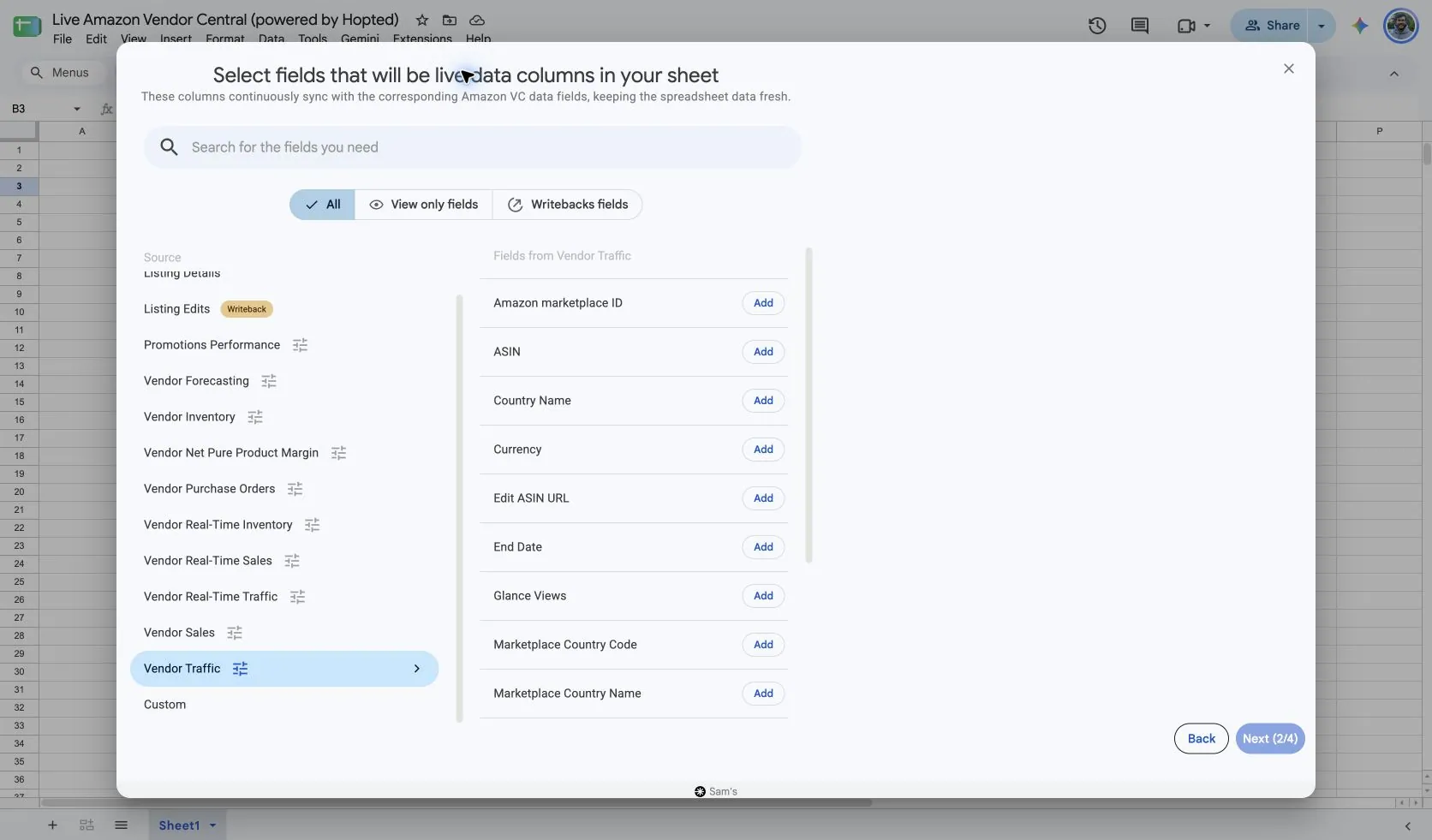
Select Vendor Traffic in Hopted. Start with Include records from: Previous calendar month and Reporting period: Month to create a completed-period review. Keep both date fields in the sheet so a later refresh remains easy to interpret.
Use Day for a short daily comparison or Week for full past calendar weeks when you need more detail. Hopted currently supports Day, Week, and Month for this source. The date selection must agree with the reporting period; a rolling day range is not interchangeable with a complete calendar week.
This source does not expose the Distributor view or Selling program settings used by Vendor Sales. When comparing the reports, keep the shared ASIN, marketplace, and dates aligned.
3. Review optional filters
Leave filters unset for a broader import, or add a filter for the specific records you want to review. Check account, date-range, and filter choices when an expected result is missing.
4. Choose a refresh schedule
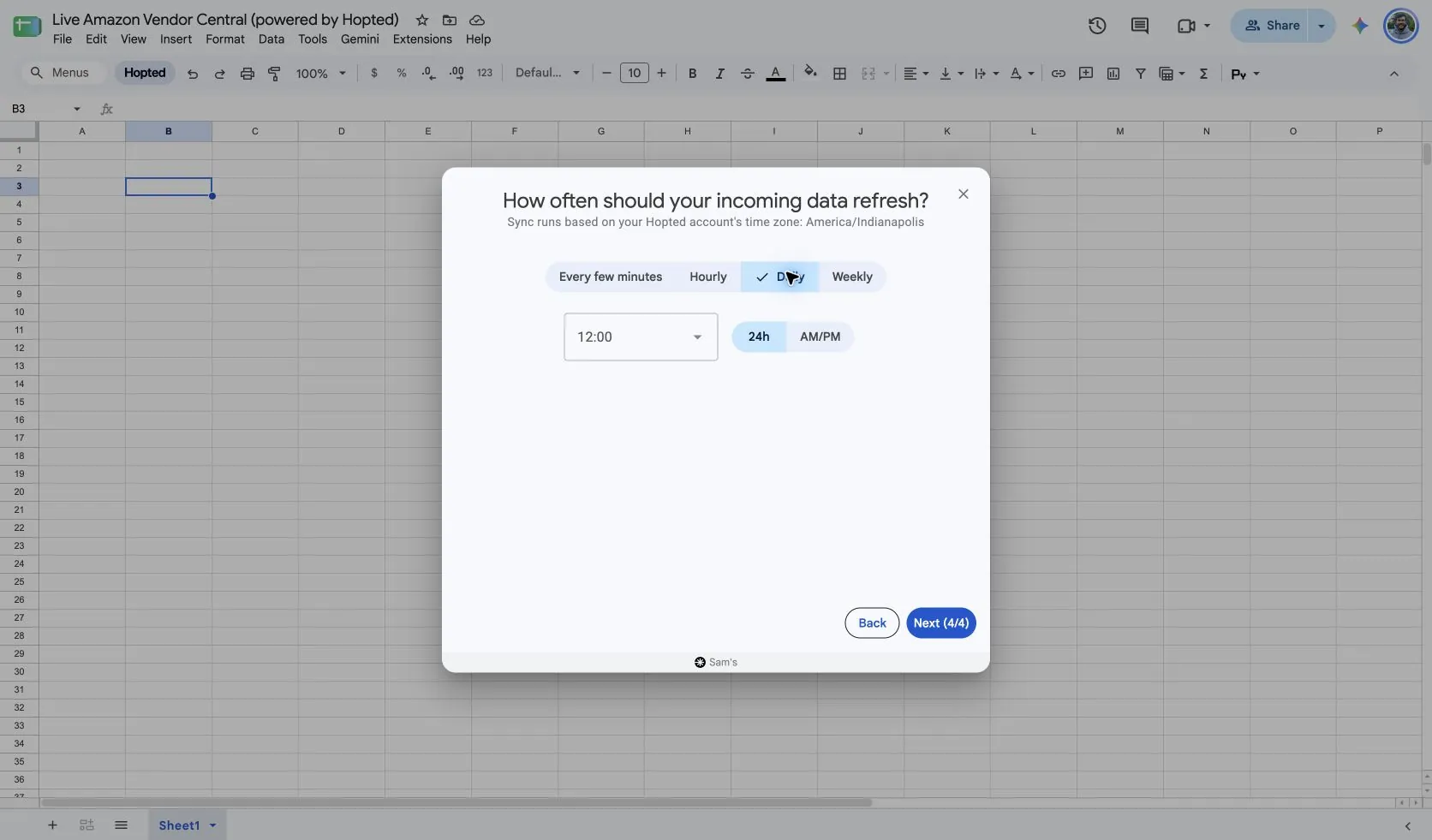
Hopted offers every-few-minutes, hourly, daily, and weekly schedules. The schedule uses the time zone shown for your Hopted account. Choose a cadence that fits the report and your review; a faster schedule cannot make Amazon publish data sooner.
5. Review and create the Sync
Check the accounts, selected fields, source settings, filters, and refresh schedule. Choose Create new Sync when the configuration is ready. Review the imported rows before adding calculations or sharing a dashboard.
How to use the report
- Rank products by Glance Views and compare the ranking with Vendor Sales. This identifies high-interest products that merit a closer review of availability, price, or content, without assuming that traffic alone guarantees sales.
- Build a trend chart for a stable set of ASINs across completed periods. Review both absolute views and the change from the previous period. A change in catalog coverage can alter the total, so inspect product-level rows before declaring a demand trend.
- Compare traffic with sales and inventory for the same ASIN and period. A simple units-per-view ratio can be a useful internal indicator, provided the units and views cover the same scope. Label the calculation clearly rather than calling it a unique-customer conversion rate.
What to check before comparing results
Glance Views are not unique visitors or sessions. One shopper can generate multiple views, and the report does not tell you which advertising campaign caused a visit. Use Amazon Ads reports when your question is about paid-media delivery or attribution.
Standard Vendor Traffic follows Amazon’s reporting-period publication cycle and documented PST convention. Recent figures can differ from hourly reporting or an unfinished dashboard period. Hopted refreshes available Amazon data; it does not make that data final sooner.
Availability depends on the vendor account, marketplace, permissions, and the data Amazon supplies. Keep row dimensions intact when joining reports. For longer-term comparisons, review Hopted Data history.
Questions and answers
How do I export Vendor Traffic to Google Sheets?
Open Hopted in Google Sheets, choose Amazon Vendor Central, select your vendor accounts, and choose Vendor Traffic. Add the columns you need, review its settings and optional filters, then choose a refresh schedule and create the Sync.
Are Glance Views the same as advertising impressions?
No. Glance Views refer to product detail-page views. Advertising impressions count ad delivery and belong in Amazon Ads reporting.
Can I calculate a conversion rate from this report?
You can create a clearly labeled sales-to-views indicator using matching Vendor Sales data. It is not a unique-customer conversion rate, because Glance Views do not count unique shoppers.
Sources and verification
Source names, example fields, and setup screens were checked in Hopted’s Vendor Central picker on October 14, 2026. Screenshots come from the supplied “Live Amazon Vendor Central (powered by Hopted)” Google Sheet.
See the Amazon Vendor Central connector for the connection overview, or return to the Vendor Central reports directory.