Amazon FBA Fees: When Product Measurements Go Wrong
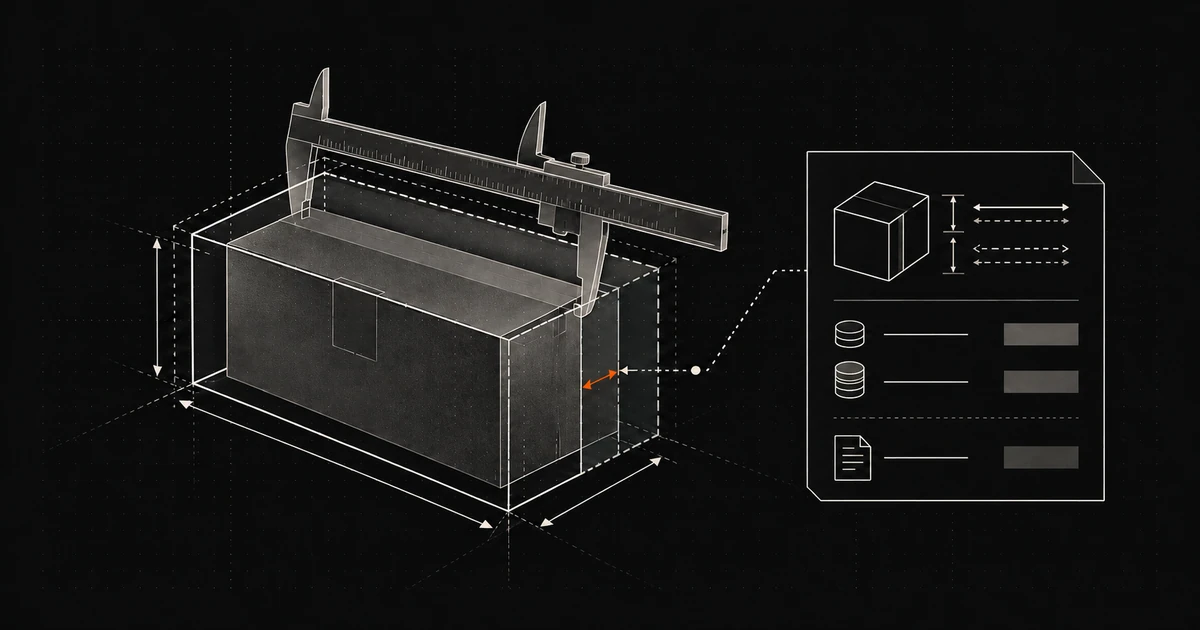
Fulfillment by Amazon fees can be a moving target, yet they are a vital part of a product’s margin. A change can come from Amazon’s rate schedule, a different package, or an incorrect weight or dimension. The first job is to find which one you are dealing with.
This guide uses Amazon’s US store and policies reviewed on October 16, 2026. The method is straightforward: compare the packaged product with Amazon’s records, reconcile the fees actually charged, then request a review when the evidence points to an error. Other stores have their own rates and policies.
A small fee difference, repeated many times
Consider a hypothetical discrepancy of $3.42 on each of 600 shipped units. The amount to investigate would be $3.42 × 600 = $2,052. These are illustrative numbers, not current Amazon rates or a reimbursement promise.
It is tempting to stop at that multiplication. But you still need to establish the correct fee for each charge date, identify the affected transactions, and account for adjustments already received. Today’s fee estimate multiplied by last month’s sales is not proof of a past overcharge.
Save the source rows and the date you noticed the change. A neat total is useful, the detail behind it matters more.
How are the dimensions calculated?
Measure the individual unit with its packaging, as the customer would receive it. The bare product, its retail package, and a shipping case containing several units can have different measurements. If you sell a set, measure the items packaged together as that set. Amazon’s product dimensions and volume guidance explains this distinction.
Amazon uses sensors throughout its fulfillment centers. Its packaged-item measurement guidance says measurements run edge to edge, including loose poly bag material and protruding handles. A bulge, flap, or inconsistent package can therefore matter even when the item inside has not changed.
For a comparable check, put a complete packaged unit on a flat surface, extend loose material, and measure its longest, median, and shortest sides at their maximum extent. Weigh the complete unit too. Amazon may verify measurements using representative samples; when your measurements differ from Amazon’s verified data, Amazon’s data governs its fee calculation.
The product size tier uses packaged dimensions and weight. Dimensional weight is a separate calculation based on volume. For US FBA, Amazon’s dimensional-weight formula divides length × width × height in inches by 139 to obtain pounds. Small Bulky, Large Bulky, Overmax, and Extra-Large calculations apply a minimum of 2 inches to width and height.
Do not use the formula as the fee itself. The applicable tier determines whether unit weight or the greater of unit and dimensional weight is used. The current US schedule uses unit weight for Small standard-size and Extra-Large 150+ lb; the other tiers use the greater value. Apply the current fee band and its increments rather than rounding every product to a whole pound. See the current US fulfillment fee schedule for the relevant category, price band, rate period, and surcharge.
What to do when mismeasurements occur
A higher fee deserves a check; it does not establish a measurement error. Follow the same process when a measurement looks too low. Keeping an inaccurate record is a poor basis for your next buying decision.
Find the product and the measurement. Use the SKU, FNSKU, marketplace, dimension units, and weight units to match the right package. Keep your measured baseline beside Amazon’s reported values.
Separate estimates from charges. The FBA Fee Preview report contains estimated selling and fulfillment fees, plus measurement fields. Amazon’s report documentation says its content is updated at least once every 72 hours and it can be requested once per day per seller. It is useful for investigation, but it is not an instant change alert or a bill. Check the corresponding fee reports and financial transactions for the amounts charged.
Rule out a legitimate change. Compare the same fee component, package version, category, price band, and effective rate period. Keep storage charges separate from fulfillment charges. A seasonal rate or applicable surcharge can change a bill without changing the product’s dimensions.
Request a remeasurement when justified. In Seller Central, search for remeasure and follow the current widget. Amazon must be able to access a unit from your inventory. The same FNSKU cannot be remeasured more than twice within the preceding 60 days, and your account also has a monthly request limit shown in the tool. Do not assume every account has the same allowance.
Request reimbursement within the policy window. Under the US weight-and-dimensions reimbursement policy, submit the request within 90 days of the fee charge. Amazon must confirm the fee used inaccurate weight or dimensions. The policy allows one claim per fee charge; one request for an FNSKU is sufficient, rather than a separate request for every order.
Include the relevant fee data, the discrepancy, package measurements and supporting photos, the affected period, and any existing case reference. Follow the tool’s evidence requirements. A supplier specification can help explain the issue, but it does not override Amazon’s verified measurement.
Amazon’s guidance says remeasurement typically takes 10 days, and the reimbursement policy asks for 10 days to review a request. Treat that as review guidance, not a guaranteed completion date. Record the result, check subsequent charges, and reconcile any approved credit against the amount you expected. Changing the measurement and reimbursing earlier charges are separate things to verify.
For a spreadsheet workflow, see Hopted’s FBA Fee Preview guide and financial transactions guide. Keep downloaded or refreshed report data, your own measurements, and the case log together. A refresh schedule does not make the underlying Amazon report real time.
How to make decisions going forward
Packaging is a margin decision as well as a protection decision. Compare proposed packages with the current size-tier boundaries before ordering a large batch. Do not remove necessary protection simply to make a box smaller.
For example, a hypothetical 17 × 13 × 6.1 inch package has a volume of 1,348.1 cubic inches. Dividing by 139 gives approximately 9.70 lb of dimensional weight before applying the relevant fee band. That does not tell you the final shipping weight or fee: unit weight, classification, and the current schedule still matter.
Reducing the shortest side can remove more volume for an equal one-inch reduction, because the other two sides form the largest face. That is a mathematical observation, not a universal packaging rule. Reducing a longer side might be what gets you below a size-tier boundary; a minimum-dimension rule or a higher unit weight might also limit the benefit.
Test the actual packaged unit and leave room for normal manufacturing variation where you can. A design exactly on the boundary is harder to keep consistent. This is fussy work but easier to do before the next production run.
Brand protection and packaging consistency
Investigate a fee discrepancy through measurements and fee records. A competing offer on the same ASIN does not establish that another seller caused it. If you also suspect a counterfeit or an incorrect product, handle that evidence separately using the appropriate listing-hijacking reporting process.
For fee accuracy, start with what you can check: give suppliers a consistent packaging specification, inspect samples from new batches, retain dated measurements, and review reported changes. Keep a clear record when you intentionally change a package. That makes it easier to explain which version your evidence describes.
Review the storage-cost guide when the unexpected charge concerns inventory sitting at Amazon, rather than a fulfilled unit. Those costs need their own reconciliation.
Keep the measurement and the money connected
Small differences can add up. The useful habit is to notice them, establish the correct packaged measurements, and connect the evidence to specific charges before requesting a correction. Keep a seperate record of the measurement result and the reimbursement result so neither gets lost in a closed case.
For the wider budget beyond measurement errors, use our Amazon seller fees and costs guide. Accurate fee records help you decide what to change; they do not guarantee a recovery or a profitable product.
Adapted from an article originally published on Bindwise; reviewed and updated for Hopted by Vlad Rudenko and the Hopted editorial team.