Sponsored Brands - Campaign Placement: export and sync to Google Sheets
Compare Sponsored Brands results across placement classifications.
What this report tells you
Placement Classification adds the location breakdown to campaign performance. This lets you check whether a campaign’s overall results hide a placement that delivers different engagement or attributed sales.
For Sponsored Brands, Hopted exposes engagement and attributed outcome fields appropriate to each report. Some reports also include new-to-brand and video measures. Choose fields for the campaign’s objective instead of expecting every report to contain the same columns.
Useful columns to start with
Choose columns for the question you want to answer. These are a starting set from Hopted’s report picker, rather than an exhaustive field list.
- Campaign Id — Use a stable campaign key for grouping and joins.
- Placement Classification — Separate placement results within a campaign.
- Impressions — Measure reported ad delivery.
- Clicks — Review engagement with the ad.
- Cost — Track advertising cost.
- Sales — Review the report’s attributed sales.
Add Profile ID, Store name, the date field, and Currency where available. They help keep accounts, periods, and monetary amounts distinct.
How to export Sponsored Brands - Campaign Placement to Google Sheets
1. Connect Amazon Ads to Google Sheets
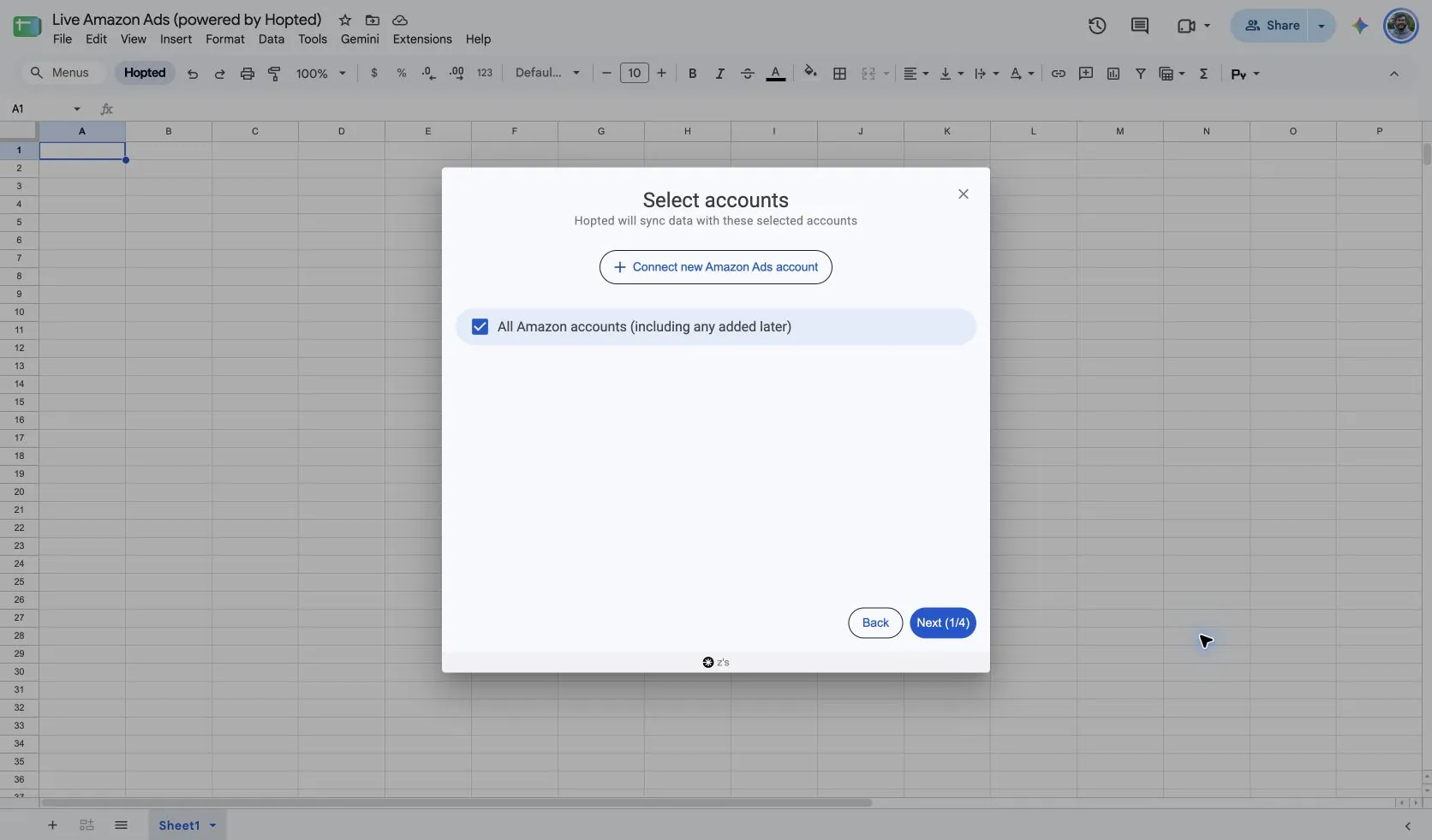
Install Hopted and sign in. To connect Amazon Ads to Google Sheets, open your spreadsheet, click Hopted, then Add new data sync and Amazon Ads. Connect an Ads account if you have not linked one yet, then select the profiles to include. For an account-wide view, choose All Amazon accounts (including any added later).
2. Choose the source, reporting period, and columns
Choose Sponsored Brands - Campaign Placement in the source list. Open its settings to review the reporting period, then use Add beside the columns you want. The screenshot below shows this report in the current Hopted picker.
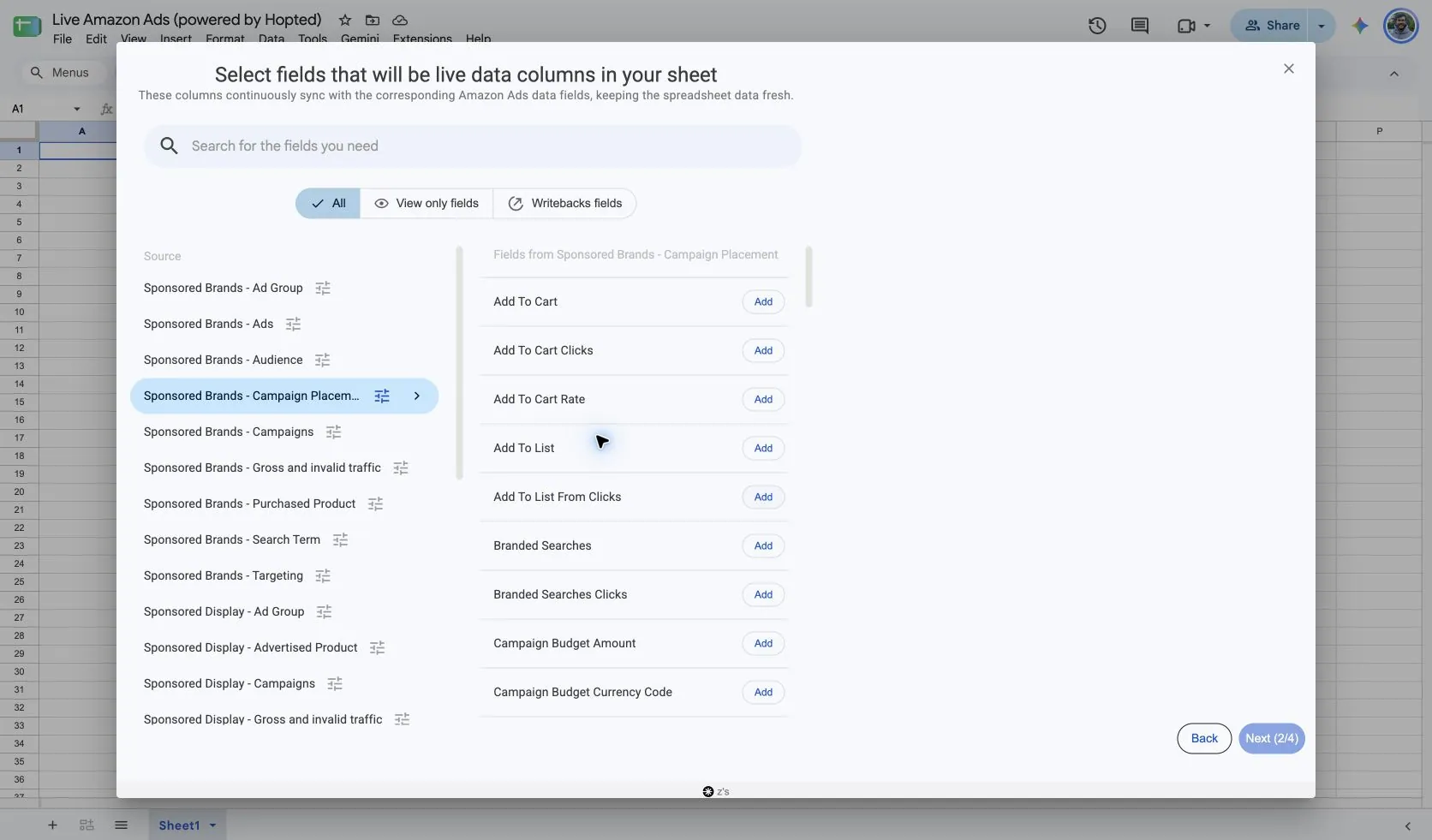
The source settings include a reporting-period choice, such as Previous 30 days. This controls which records are requested; it is separate from the attribution window named in a metric.
3. Review optional filters
Use filters when you want a focused view. Leave them unset for a broader import. Check filters when a result is missing, before assuming the report contains no data.
4. Choose a refresh schedule
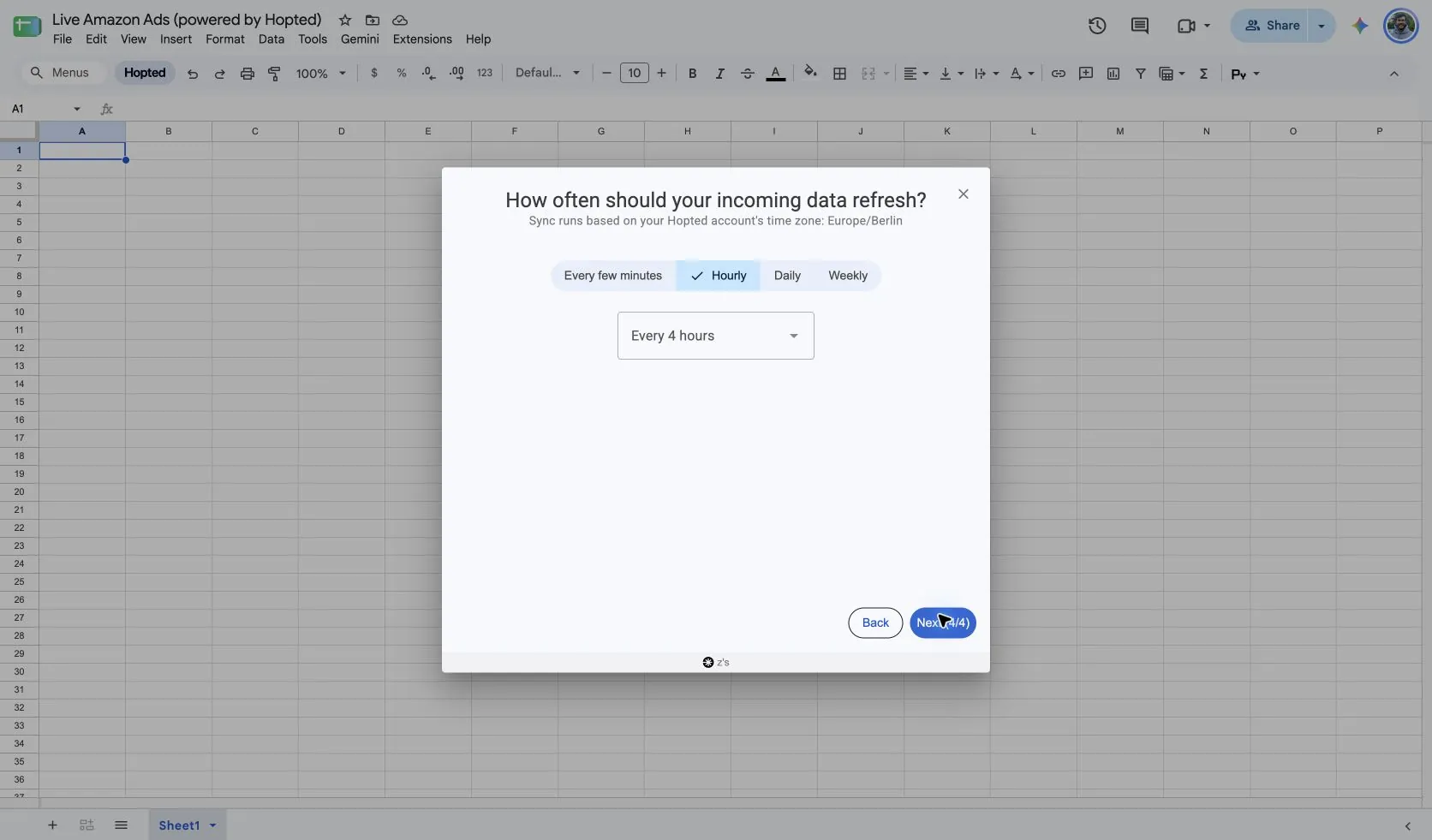
Choose the refresh cadence in Hopted: every few minutes, hourly, daily, or weekly. The schedule screen shows the Hopted account’s time zone. Select a cadence that suits your review and the source’s data availability.
5. Review and create the Sync
Check the accounts, selected fields, filters, and schedule on the review screen. Click Create new Sync when the configuration is ready. Review the imported rows in your Sheet before building formulas or sharing a dashboard.
How to use the report
- Compare placement classifications within the same campaign, rather than using one placement’s result as the total for that campaign.
- Track changes in the placement mix alongside cost and attributed outcomes after a campaign adjustment.
- Use placement findings to decide which campaigns deserve a closer bid or creative review in Amazon Ads.
For a sales-efficiency review, calculate ACoS = advertising cost ÷ attributed sales × 100% and ROAS = attributed sales ÷ advertising cost. Use the same currency, reporting period, and attribution basis. Calculate ratios from summed amounts rather than averaging row-level percentages; leave a ratio blank when its denominator is zero.
What to check before comparing results
Keep Placement Classification in your row key. Repeated campaign attributes such as daily budget are contextual values and should not be summed across placements.
Availability depends on the connected profile, marketplace, ad activity, and Amazon’s reporting support. A source appearing in Hopted’s picker does not guarantee rows for every account. Recent results may change as Amazon updates reporting.
Keep each report’s row dimensions intact. Do not add together overlapping breakdowns or combine different currencies without a deliberate conversion. For historical comparisons beyond the source’s available period, review Hopted Data history.
Questions and answers
How do I export Sponsored Brands - Campaign Placement to Google Sheets?
Install Hopted, open a Google Sheet, choose Amazon Ads, select your connected accounts, and choose Sponsored Brands - Campaign Placement as the source. Add columns, review the reporting period and optional filters, then choose a refresh schedule and create the Sync.
Which columns should I start with?
Start with Campaign Id, Placement Classification, Impressions, Clicks, Cost. Keep account, date, and currency context where available. You can choose additional fields in Hopted for the review you are building.
Why can the latest results change after a refresh?
Amazon can update recent attributed results as data matures. A Hopted refresh retrieves available data; it cannot make unfinished attribution final. Compare matching reporting periods, currencies, and attribution definitions.
Sources and verification
Report name, setup screens, and example fields checked in Hopted’s Amazon Ads picker on October 13, 2026. Screenshots were captured from the “Live Amazon Ads (powered by Hopted)” Google Sheet.
Amazon Ads campaign reporting provides Amazon’s reporting definitions. See the Amazon Ads connector for the connection overview, or return to the Amazon Ads reports directory.