Sourcing Amazon Products at the Canton Fair and Other International Trade Shows
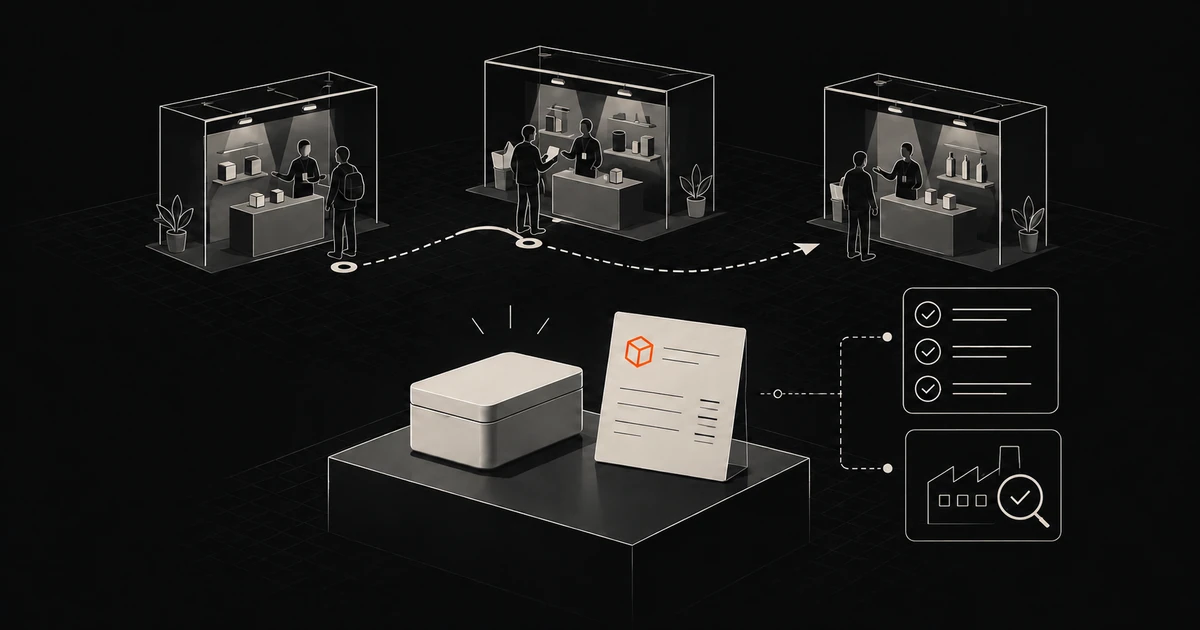
Jumping on a flight to source Amazon products at the Canton Fair can be exciting. The harder part is coming home with a useful shortlist, comparable quotations and a clear idea of what to check next.
This guide follows the practical order of a first sourcing visit: plan the right days, compare samples, ask better questions, protect your product information and arrange factory visits where they make sense. A good conversation at a booth is a starting point for verification.
Adapted from an article originally published on Bindwise by Joshua Smith and Alex Borisenko-Markovich; reviewed and updated for Hopted by the Hopted editorial team.
Prior planning
The Canton Fair is the China Import and Export Fair in Guangzhou. Before booking, use the organizer’s current calendar to match your products to the correct phase. For the 140th fair in autumn 2026, the three phase themes are Advanced Manufacturing, Quality Home Life and Better Life. The dates and exhibition sections belong to that session; check the next session separately.
Do not plan from an old product-category list. For example, the official Phase 2 floor map for the 140th fair includes Building and Decorative Materials, Furniture, Kitchenware and Tableware, and Household Items. A supplier you want to meet may be there for only the relevant phase.
1. Make a supplier and product list
Write down what you are actually trying to source before filling the calendar with meetings. Include the intended customer, materials, dimensions, target quality, packaging, expected order quantity and the countries where you intend to sell. Leave room for useful discoveries, but give the trip a purpose.
Contact suppliers you have already shortlisted online and ask whether they are exhibiting. Confirm the company name, phase, booth number and person you will meet. Use a contact channel you have independently checked. A familiar display name in a messaging app is not enough to verify a company.
Group appointments by hall and leave time between them. Keep the organizer’s floor map available, together with a simple list of must-see booths and optional ones. The first day can feel a bit much, it settles down.
2. Sort out the practical travel details
Check the current overseas buyer badge guide before leaving home. The September 2026 guide lists an original eligible identity document, a business card and the pre-registration QR code receipt for a new badge application. Read the full guide for your document type and collection location; do not assume an old badge or a screenshot of an ID will be sufficient.
Arrange entry permission separately. Check the Chinese embassy or consulate requirements for your passport, residence and itinerary, including whether you need a visa. Event registration is not a substitute for immigration permission. If an invitation is needed, use the organizer’s current attendance guidance and confirm which invitation documents your consulate accepts.
Choose accommodation by the journey to the fair complex as well as the room price. Ask the hotel to confirm any shuttle, its pickup point, operating dates and timetable in writing. Save the hotel and meeting addresses in Chinese and English. Plan meals around your dietary needs, and check customs rules before carrying food across a border. Confirm transport and hotel services directly before relying on them.
Choose other international trade shows the same way
Start with product fit, rather than the size or reputation of an event. Look at the current exhibitor list, buyer admission rules, dates and exact venue. For Hong Kong events, the Hong Kong Convention and Exhibition Centre’s calendar identifies events and their organizers. Follow through to the individual show’s official information before booking; that venue calendar does not cover every Hong Kong fair.
Compare the cost of the trip with what you expect to learn. A specialist event closer to home may be a better first visit than a long trip with no supplier shortlist. There is no requirement to visit China to build a viable Amazon business.
Sample inspections and supplier questions
At the booth, compare the product as carefully as the sales pitch. Use the same questions across your shortlist so that a low quote does not hide a different material, smaller pack or missing component.
- Compare samples against a written specification. Note the model, material, dimensions, finish and included accessories. Ask which changes the supplier can make and what they cost. Keep photographs and sample identifiers with the quotation, after asking permission to photograph.
- Check intellectual property before committing. Ask who owns the design, brand and tooling, and what rights the supplier can actually grant. An exhibitor’s assurance is not a clearance search. The US International Trade Administration’s China market-entry guidance recommends early IP protection and qualified local advice. Consider both the manufacturing country and your selling markets.
- Request comparable written quotations. Record the minimum order quantity (MOQ), quantity price breaks, currency, validity, payment terms, production lead time and agreed shipping terms. Ask when the lead-time clock starts. A printed price list is convenient; it does not establish honesty or make two quotations comparable by itself.
- Ask for the compliance evidence for the exact product. Identify the applicable requirements in each destination market before placing an order. For US consumer products, the CPSC Online Sellers’ Safety Guide is a useful starting point for product-specific testing, certification and labeling resources. Do not treat a certificate for a different model as proof for your item, or assume one document covers every market.
- Look at the packaging too. Ask for the retail packaging, carton quantities, packaged dimensions and weights, instructions and labeling proposal. Include any changes in the quote. Assess the sample and packaging before agreeing that they are ready for production.
- Keep a memorable contact record. A photograph together can help you remember the meeting, if everyone agrees. It is optional. The important record is the representative’s name, company, booth, product reference and the next action you agreed.
Bring business cards or another reliable way to exchange your company details. Write a short note straight after each meeting while the differences are still clear. A little boring perhaps, but useful when ten similar samples reach your desk.
eCommerce and competitors
Present the business you actually run. If you sell directly to consumers in the US, “US direct-to-consumer brand” may describe you well; if you sell on Amazon, say so when discussing channel requirements. Do not invent a distribution business or purchasing volume to try to secure a better quote. Clear specifications and realistic quantities give you a sounder basis for comparison.
Discuss confidentiality, designs, tooling and any exclusivity before sharing detailed files. If you already work with an exhibiting supplier, agree what it may display or offer to other buyers. Put those terms in an appropriate written agreement. Paying for a product or calling it “our design” does not, by itself, establish that every form of display or sale is prohibited.
If a conversation involves sensitive product information, arrange a private follow-up rather than discussing it across a busy booth. Dress comfortably and professionally for a day of walking and meetings. Treat suppliers as individual businesses; nationality, clothing and fluency are poor substitutes for checking what a company can deliver.
Factory inspections
A factory visit can help you understand a shortlisted supplier’s operation. Arrange it around the actual address, travel time and availability of the people you need to meet. A company exhibiting in Guangzhou may manufacture elsewhere, so leave enough time or plan a separate visit.
First establish whether you are dealing with the manufacturer, a trading company or an agent, and who will contract with you. Ask for the Chinese legal company name, business license, registered address and the production location. Compare these with independent records and verify that the representative can act for the company. The Canadian Trade Commissioner Service’s China due-diligence guide explains these identity and authority checks. Its assistance is aimed at Canadian businesses, but the verification questions are useful more broadly.
During the visit, ask to see the processes relevant to your product: production, incoming materials, quality checks, traceability, packing and handling of rejected units. Discuss which work is subcontracted. Bring an interpreter or independent specialist if the conversation requires it. A tour of a tidy building does not establish production capacity or regulatory compliance.
Replace a friendly “yes” with an agreed specification, an approved sample and measurable acceptance criteria. Consider independent inspection and testing appropriate to the product and order. Keep your decision tied to the evidence about the company and its production processes.
Before paying a deposit, finish the commercial calculation. Include the product, packaging, inspection, testing, freight, duties, import costs, storage, Amazon selling and fulfillment fees, advertising and a realistic allowance for returns. Our Amazon seller cost guide covers the Amazon side of that calculation for the US store. Use your own landed-cost estimate and conservative demand assumptions; a fair quotation does not prove that the product will sell profitably.
Bring home a shortlist, then follow through
The useful outcome is a small set of suppliers worth checking further, with sample references, comparable prices and clear next steps. Send each serious contact a brief recap of what you discussed and ask them to confirm the points that matter.
Then compare the samples, verify the companies and documents, resolve the terms and decide whether a pilot order makes sense. A sourcing trip can move that work forward. It does not remove the work, and coming home without placing an order can still be a sensible result.